
If you’ve been staring down a dozen AI tools, wondering which one’s actually worth your time, you’re not alone.
The people rushing ahead? Most of them don’t know what they’re doing either.
Thoughtful beats fast every time.
You open an article to make sense of it all, and by paragraph two, it’s telling you to “start with customer engagement” or pick between Gemini, Copilot, and ChatGPT like you’re buying a new printer.
Meanwhile, your team’s still treating AI like a smarter Google search, and quietly wondering if they’re missing something. They’ve got five tools open that all blur together, and every article assumes they’ve got hours to “explore use cases.”
All the AI ideas you run into sound abstract, like strategy decks without the strategy. You feel like you’re missing steps, and honestly, you probably are. Most people sharing this stuff are talking at a level that skips the messy middle where real teams actually live.
It’s not that you’re confused. It’s that no one’s actually meeting you where you are, managing real work, with real humans, trying not to waste time or money on the wrong thing.
So here’s the approach I recommend, the one that actually sticks, doesn’t require a full rebuild, and respects how your team already works.
The tool advice you keep hearing (and why it’s not wrong)
Here’s what most AI recommendations boil down to:
- If you’re in Google Workspace, use Gemini
- If you run on Microsoft, go with Copilot
- If you want something flexible and general, try ChatGPT
All of that is totally reasonable.
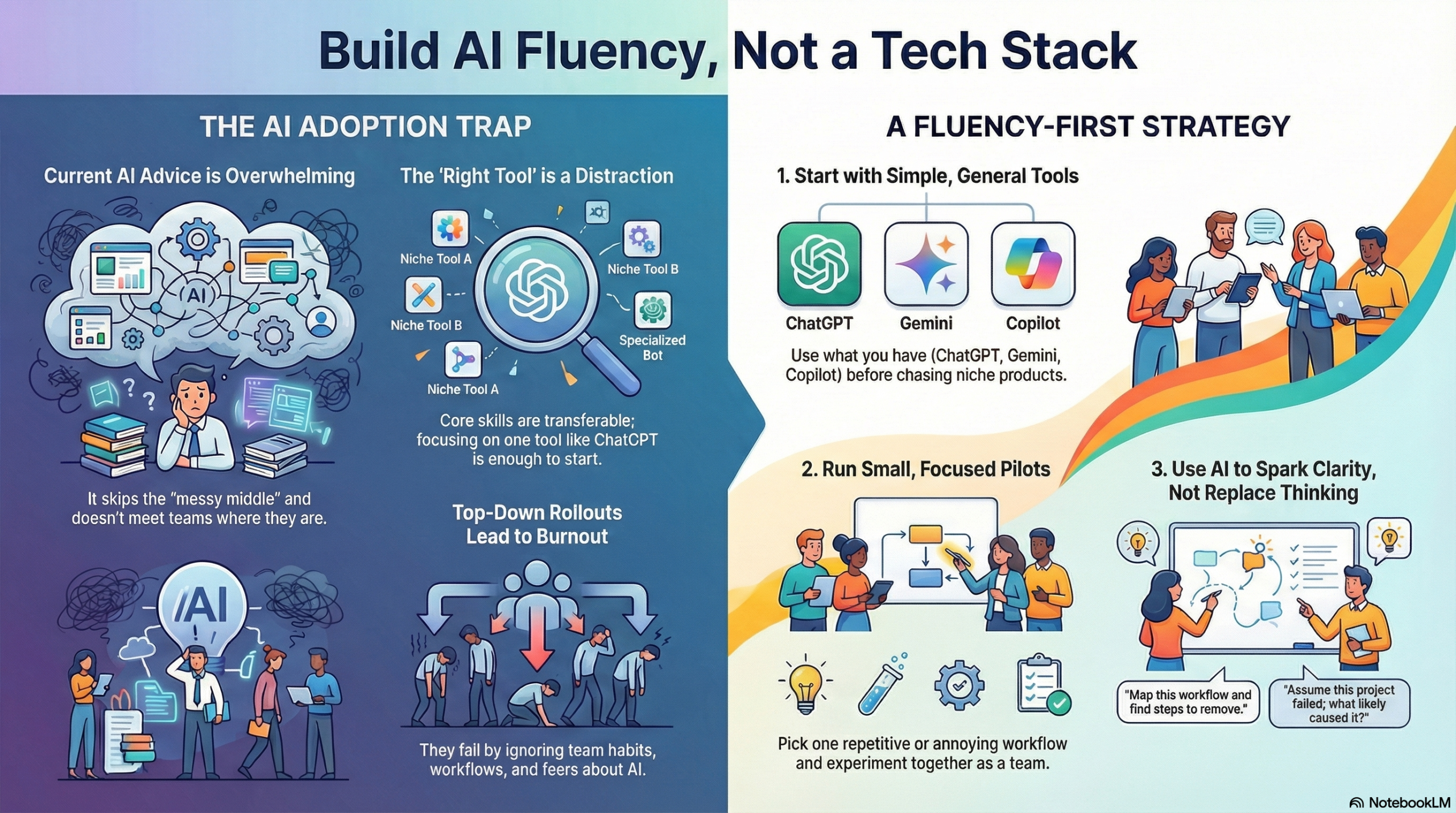
Personally, I recommend ChatGPT for most teams starting out. It’s the easiest place to build shared habits. It’s fast, forgiving, and doesn’t require a degree to use well. Gemini is improving fast, and if you’re already deep in Google, it might eventually make more sense.
But the part no one talks about? These tools all do roughly the same thing.
Once your team gets comfortable with one, the skills transfer.
Same with the mindset. Same with the confidence.
Which means the tool itself isn’t the point. I’m just telling you what I’d pick to start to narrow the choices so you don’t have to decide.
Skip the shiny. Start with fluency.
If you’re leading a team, your first phase of AI use should feel simple. Even boring.
Start with what’s already available:
- ChatGPT
- Gemini
- Microsoft Copilot
- Claude (if you’re looking for a more analytical tone)
And use the AI features already built into the tools you use every day. Gmail, Docs, Notion, Word, Slack. Start there.
Avoid the “niche-but-powerful” AI tools for now. Not because they’re bad, but because they make it harder to spot what’s signal and what’s noise.
Until your team has a basic understanding of what general-purpose AI tools can do, there’s no way to tell if the new thing on Product Hunt is actually helpful or just marketed well.
The goal isn’t to build a tech stack, it’s to build habits so that fluency comes first and the rest is optional.
Run a pilot.
Most teams approach AI adoption like software implementation. Big decisions, long trainings, full rollouts. Then quiet burnout when no one uses the tool three months in.
Try this instead:
- Pick one workflow that’s repetitive, manual, or just plain annoying. Think: onboarding steps, internal reporting, meeting prep, cross-functional status updates, vendor comparisons.
- Give it any data it needs to assess (dashboard screenshots, pdfs, csv files, documents). A few smart starting points:
- Process mapping & simplification – “Map this workflow and identify steps that can be automated or removed.”
- Pre-mortem analysis – “Assume this project failed. What likely caused it?”
- KPI prioritization – “From these metrics, identify which three deserve attention this quarter.”
- Analytics interpretation – “Review this dashboard and summarize what actually changed and why it matters.”
- Onboarding path customization – “Given this person’s role, seniority, region, and tools, generate a personalized onboarding checklist and timeline.”
- Decision justification support – “Compare these vendors and help me build a rationale based on different priorities,cost, speed, integration, etc.”
- Tack on to any of these: “Ask me one question at a time to help fill in any gaps that might be missing.”
- Use the conversation to surface ideas, spot blind spots, and simplify thinking. You’re not looking for a perfect output. You’re looking for clarity.
- If something is useful, keep it. If not, move on. The point is to spark better decisions, not replace them.
Do pilots together as a team. Let individuals experiment inside their own roles, but bring findings into a shared conversation. What feels useful in isolation becomes repeatable when it’s socialized.
That’s where the real adoption happens. Not from top-down mandates, but through smart, shared experimentation.
Why IT can’t lead this alone
This is where a lot of AI efforts quietly stall out.
IT is great at security, infrastructure, integrations. But they don’t always have visibility into:
- how work actually gets done
- where friction lives inside workflows
- what tools people default to under pressure
- how people feel about using something new
And that matters. A lot when introducing AI tools into the team workflows.
AI tools aren’t just technical. They’re personal. People resist them for reasons that rarely show up in onboarding documents: fear of looking incompetent, not wanting to slow the team down, feeling overwhelmed by one more thing, and yes job security.
If no one’s addressing those realities, adoption won’t happen, no matter how good the tool is.
What an AI operations partner actually does
This is where the right kind of outside help makes a real difference.
An AI operations partner doesn’t show up with a pitch deck full of tools. They focus on how your team already works, and how to make those workflows smarter, not more complicated.
They help you:
- Identify low-risk, high-impact use cases
- Run structured experiments that teach you something useful
- Build shared norms for how AI is used
- Set realistic guardrails (and skip the hype)
- Avoid spending money on tools that add noise instead of clarity
They translate AI into something practical and human to fit your team. The only AI strategy that works is one your team will actually use.
Where to start instead
Start by getting clear on how your team actually works. Where does time get burned? What tasks feel heavy or unclear? Where would support help, not replace, the thinking?
You don’t need to begin with customer engagement. And you definitely don’t need a long list of tools to evaluate.
Build fluency first. Use what you already have. Focus on confidence before complexity.
Everything else, tools, integrations, even ROI, gets easier once that foundation is in place.
Want help making smart decisions without wasting time or turning your team into guinea pigs?
That’s what we do. Let’s Talk
